
Why are spatial disorientation accidents on the rise?
Air Facts Journal
Spatial disorientation kills. All pilots know this intuitively, but the statistics back up the gut feel: 94% of fixed-wing general aviation accidents involving SD are fatal, a shocking number that hasn’t changed much over the last four decades. So while these accidents make up a small percent of total accidents (see this article for the details), they still make up a significant share of all fatalities.
If those numbers don’t surprise you, this fascinating study from earlier this year should.
More tech, more accidents?
First, the researchers from the FAA show that SD accidents have not declined since 2003—in fact, quite the opposite. You might assume the widespread adoption of tools like datalink weather, modern autopilots, reliable AHRS, and electronic flight bag apps would make VFR-into-IMC (the classic SD accident scenario) much less common. It’s easier than ever to know where the bad weather is, and our avionics are more reliable than in the days of vacuum pumps and ADFs. It’s a great theory, but the numbers don’t support it:
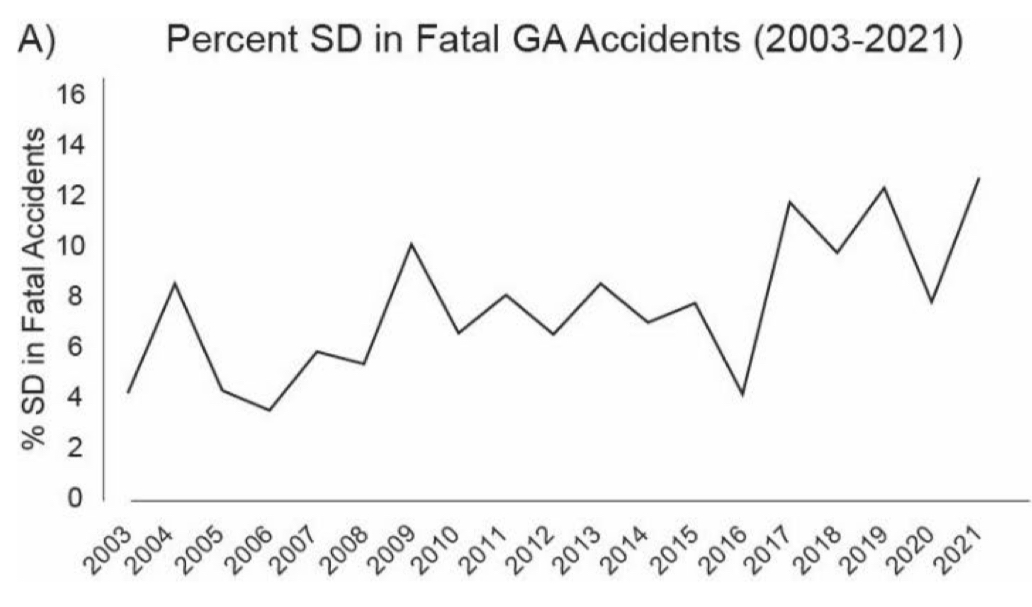
Smart students of statistics may point out that the graph above could be an example of the denominator changing (total accidents) and not the numerator (SD accidents). GA accidents overall and fatal accidents in particular are both down since the early 2000s, so if SD accidents are holding steady, they might make up a higher share of a smaller total. Again, though, the numbers disagree. Fatal GA accidents have declined from an average of 324/year in 2003-2006 to an average of 218 in 2018-2021, a drop of 33%. Over that same timeframe, fatal SD accidents actually increased, from an average of 17 to an average of 24—a 41% rise.
Better technology, but more spatial disorientation accidents. It’s certainly not what I would have guessed.
The profile of pilots who are crashing, on the other hand, is what I would have guessed: older pilots and pilots with less than 1000 hours are most likely to end up in an NTSB report for SD.
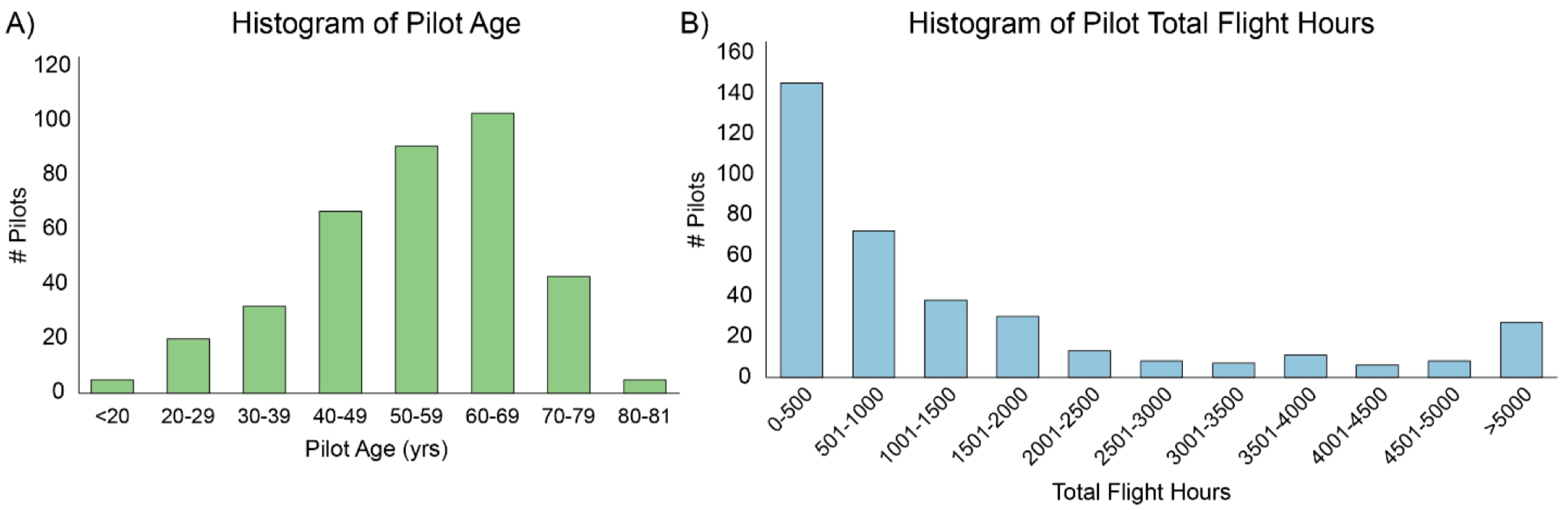
Pilots between age 50-70 make up only 26% of active GA pilots, so the first graph above might initially seem surprising since over half of the accidents involved pilots in that age range. But remember that most pilots under age 30 are either student pilots, flight instructors, or professional pilots. The GA pilots flying cross-country in marginal or IFR weather, where SD accidents typically occur, are older.
As far as flight hours, we’ve all read about “the killing zone” for pilots between 50 and 350 hours, and you can see that in the blue bars above. More experience does seem to lead to safer flying, at least in this case.
So while you could tell a story about older, less experienced pilots who get in over their heads, the evidence for this is anecdotal at best.
One other detail is definitely part of the picture: the increasing prevalence of turboprops and jets. The numbers are small here, but the trend is certainly worrying over the last decade.
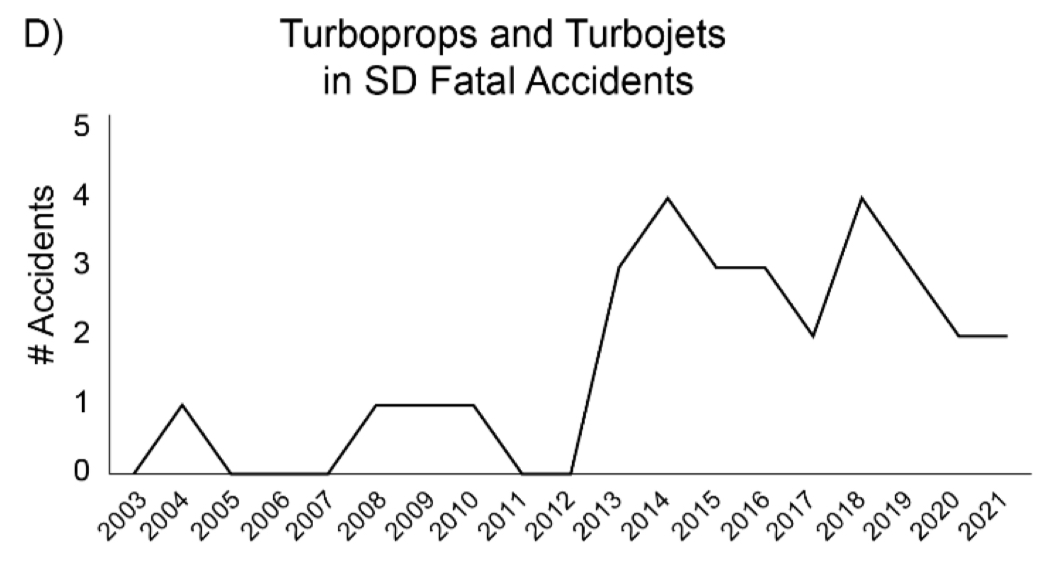
Again, though, for anyone paying attention to FBO ramps lately this makes sense. Single engine turboprops and light jets are booming, while high performance pistons are stagnant. The result is the doctor in a Bonanza 50 years ago is more likely to be a business owner in a TBM these days. Such airplanes are incredibly capable, but they are also high performance machines that can quickly get away from the pilot if they lack proficiency.
An unexpected cause
To review: against a backdrop of falling accident rates, spatial disorientation accidents have risen, and these accidents typically involve older and less experienced pilots, sometimes flying turbine airplanes.
Unfortunately, that’s not the end of the story.
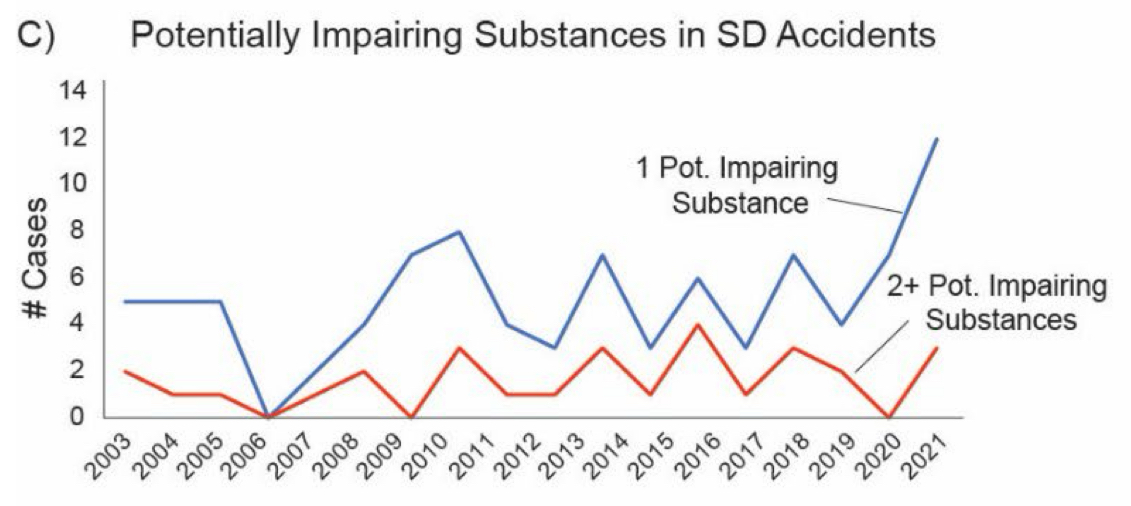
The FAA report also points out the uncomfortable reality that “potentially impairing substances” show up in an increasing number of NTSB reports. In fact, over the 2003-2021 timeframe, “A total of 90 out of 367 (24.5%) fatal pilots had a positive toxicology result.” That one quarter of accident pilots were potentially impaired seems incredibly high, and not something we should sweep under the rug.
These positive toxicology results were almost all drugs, as alcohol was a rare finding. What drugs were these pilots taking? Mostly cold medicine, but antidepressants are a close second, and even THC is creeping up:
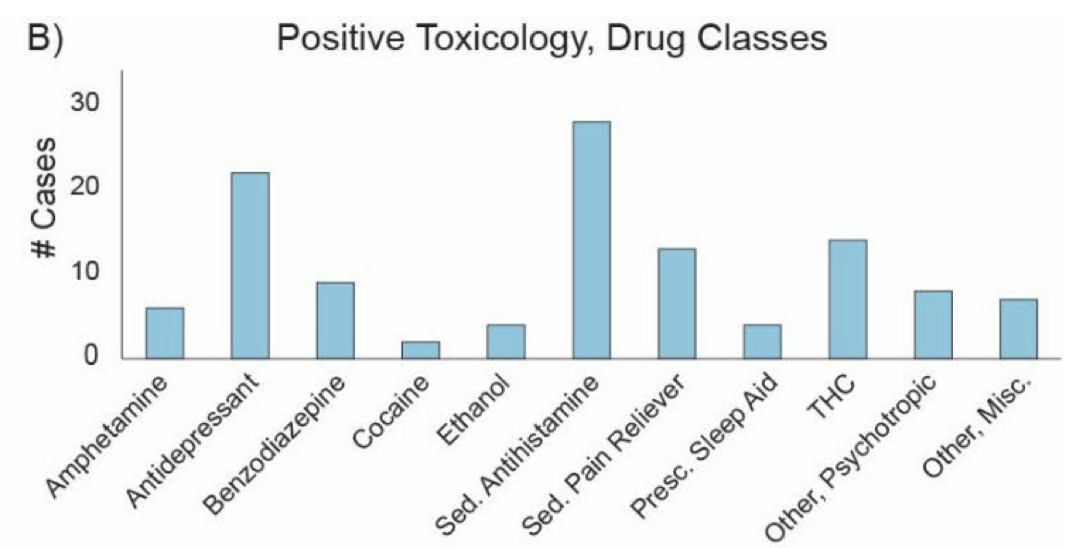
Obviously, taking a Benadryl does not lead directly to a fatal accident. But it also does not help a pilot who may be dealing with bad weather or a lack of avionics proficiency. Even worse, the report goes on to explain that “27 accidents included positive toxicology findings for two or more potentially impairing substances… 14 pilots tested positive for an illicit substance.”
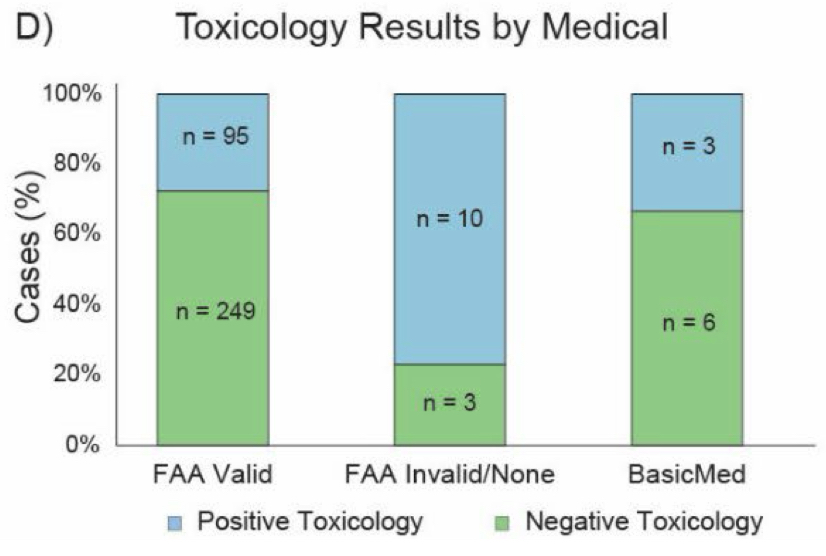
Some of these pilots are probably just rule-breakers by nature. Notice in the graph below that 77% of accident pilots who did not have a valid FAA medical tested positive for toxicology. That suggests these pilots knew they weren’t 100% healthy, and chose to fly anyway. It’s doubtful that a better flight review or a new regulation would change these pilots’ behavior. Even excluding those pilots, though, 28% of pilots with a valid FAA medical tested positive.
What to do
I’m not suggesting pilots cancel every flight when they have a sniffle, or that they resort to a caveman lifestyle and forswear all medications. I have flown with a cold and lived to tell the story, like most pilots. But these results should give us pause. Drugs clearly have an under-appreciated role in SD accidents, and that’s something that is completely under our control.
The FAA actually has a very helpful resource that explains what types of medication can be used by pilots. It’s worth reviewing as we prepare for cold and flu season, because a few minor adjustments can keep you reasonably healthy and perfectly legal. For example, if you have to fly then choose Allegra over Benadryl, Afrin over NyQuil, and Tylenol over Tylenol PM. If you’re taking serious medication like narcotic pain-killers, an honest discussion with your AME is in order.
If you are going to fly when you’re a little under the weather, try to stack the odds in your favor. Fly during the day (the statistics on SD accidents at night are terrible), have a good autopilot (know how to use it!), and consider taking another pilot along (who has been briefed on their role). Remember that Mother Nature does not care about your sinus infection or your bad back.
As sad as the statistics are about drugs, this is not the whole story—after all, 75% of SD accidents did not involve drugs. Also, SD does not necessarily mean VFR-into-IMC. While that is still the most common accident in this category, it accounts for less than 50% of fatal SD accidents. So even if you never take medication, there is plenty of work to do on basic instrument flying skills, avionics proficiency, and weather interpretation.
The NTSB data has been clear for many decades: the pilot in the left seat is the weakest link on a typical GA flight. This is not a reason to quit, it’s a reason to bring our best every time we fly. That means being healthy, unimpaired by drugs, well rested, and most of all proficient. The stakes are high, but so are the rewards.
The post Why are spatial disorientation accidents on the rise? appeared first on Air Facts Journal .